Saturday, November 17, 2012
Massacre at Black Scythe by Mikael Bergqvist
I struggled with Massacre at Black-Scythe. I wanted to like it, but I couldn't get over the fact that I wasn't given any premise at all to work with. I don't know where the story takes place. I don't know when. For a bit there, once things got rolling, I thought we were in modern america. Then I ran into a goblin.
WTFZOMGGDSAG@!
Goblin? Really dude? BEDSER!@!?
Okay, setting aside the fact that this story could NOT decide what genre it was, what I thought it did very well (when it decided to do it) was create the creepy sense of approaching the old abandoned town, the searching for a place from your dreams, the eerieness of that whole scene. Unfortunately, this falls down later when everything becomes so wierd that there's no longer a point of reference for "normal" to compare it to.
As I commented to a good friend after reading this, for something to remain creepy or horrifying, it needs to deviate from normal in significant ways. But if there is no longer any "normal" then you can no longer deviate from it. Oddities can only be eerie when they're presented against a predictable, normal backdrop. Once the whole world is odd, nothing is eerie any longer.
That and... I apparently "shredded" my legs badly enough to lose a whole liter of blood. Let me tell you, dude, if I shredded my legs badly enough to lose a liter of blood, I am NOT getting back up again. I am going on a stretcher. To the hospital. If I'm lucky. To the morgue if I'm not. The blood-loss as hit points thing was cool for a minute, but it quickly failed in practice. I lost my suspension of disbelief right there. Nailed to a wall and left behind. Goodbye suspension of disbelief! It was nice knowing you.
Finally, the nail in the coffin, as it were (for me at least) was all the Which Door choices I was given as the story proceeded. The worst was on section 51, where I had absolutely no basis to pick any one option over another. So I picked one at random and died--totally at random. I put the book down after that. Sorry. If you want me to make choices, give me Choices with a capital C. I'm not interested in playing, "let's roll the dice and see if I die."
Gamebooks are about choice. Hinging huge consequences on random results undermines the very appeal of interactive storytelling.
That said, there were moments when this story shone, and I really hope the author can move above some of the wierder mistakes (*cough* goblin wtf *cough*) and create something really awesome next time.


Friday, November 16, 2012
Sigil Beasts by Karalynn Lee
I'm going to be honest. I LOVED Sigil-Beasts. Within the first two short paragraphs, Karalynn has already painted a picture of a vivid and interesting world. I'm imagining huge, rune-covered monsters, clashing in battles that resolve the fate of nations. This is a great premise because, not only does it have raw coolness factor, it puts a lot of emphasis on the individuals who are in charge of these beasts, which is great for story purposes.
The only place I think this story falls flat is in the later chapters. I like to try to craft each possible path of a gamebook to read like a story in it's own right--just as satisfying as if it were the only narrative path the author wrote. This is a steep challenge, and I'm not sure it's actually possible, but Sigil-Beasts falls pretty far short of that (admittedly high) mark. There were several story paths that I found very unsatisfying, with strange or unsettling endings that did not leave me feeling satisfied, like the story wasn't complete.
Just a little bit more on the system side: I felt like the rule-set was just the right length, neither too heavy nor too light, with each stat serving a valid purpose. And it was surprisingly clear and concise in it's presentation, especially for someone who (I assume?) is a first timer at this. (Is she a first timer? Has she done anything else I didn't know about?) That said, the balance later in the game got very screwy. I had trouble finding any path in which my dragon could win at the end, which was very frustrating. But I didn't explore exhaustively; I may just have made the wrong choices.
Another commenter suggested that Sigil-Beasts would have been better served as a straight narrative, either a short story or a novel. I don't want to scare the author away from writing gamebooks, because I think as a whole Sigil-Beasts was utterly fantastic, but I just want to throw out there, I would LOVE to see the novel that this story could become. Everything about the story, from the premise of the world to the cool house the main character lives in--built in the bones of his old dragon--to the moral ambiguities of the whole practice of raising and fighting the Sigil Beasts... there's so much richness and depth here.
I feel like the gamebook art could be honed a bit, as far as crafting the narrative paths and making each one satisfying, but the incredibly vivid and evocative setting and world (not to mention the clear, concise, and well-written ruleset) earned my respect. This one caught my eye from the beginning and remained one of my favorites throughout. It was a hard choice, but this came out as one of my top choices: Sigil-Beasts received one of my two votes.
Thursday, November 15, 2012
Vigilante: Dark Justice
I'm actually interrupting my reviews to throw in an extra post here, mostly so that I can refer people to this post later. Though I finished and presented Vigilante in time for Convolution, and posted about the whole process throughout, I don't think I ever posted much about the game itself.
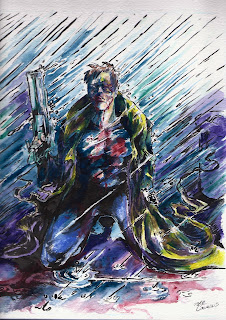
There are two things I'm excited about about this game. Well, three, really. Okay, maybe four. Let's just say five and call it a day.
One: The whole reason I built this in the first place was to test out a core mechanic that I'd been playing around with. The idea is that you roll a couple of dice and try to roll equal to or under your skill. But there's two tricks. First, a higher result is still better than a lower result, as long as you don't roll over your skill. This makes contested rolls very easy, because you can simply compare the die result. And the probabilities on this are very similar to a roll and add system like d20. The second trick is that the dice you roll are determined by the difficulty of the test. This is a complete inversion of the standard model, but I think I really like it. So for example, for an easy skill test, you would roll 2d6, whereas for a difficult skill test, you would roll 2d10. Increased difficulty past 12 can be added by adding more dice.
Two: Staying with the system for now, I'm excited about the Aptitudes and Proficiencies system. Instead of one list called "skills," characters have two sets of traits: aptitudes and proficiencies. Aptitudes are a measure of capability, rated 1-10, but they are somewhat generic. Proficiencies are binary, either you have it or you don't, and they determine whether you are trained in a specific toolset and type of activity. For example, "Target" is the aptitude related to any ranged attacks: aiming, shooting, archery, etc. But in order to use a sniper rifle, you would have to have the "rifles" proficiency. The intent is to represent the way that as people grow skilled in an area, it's easier to pick up new skills in an area. It's not perfectly accurate that if someone is trained in guns, they'll be roughly similarly skilled in all the guns they know how to use, but it's at least as accurate as the standard RPG abstractions, if not more so. And it's an attempt to resolve both skill bloat and the blurry-lines-between-skills problem with hopefully a little more elegance than Gurps, for example.
Three: I really like vanilla mortals. I don't know why, but I just do. And they get so shafted in so many systems. Look at Exalted; you're shooting yourself in the foot right off the bat if you play a vanilla mortal. Vampire, or all WoD, you completely miss out on half the system if you don't play one of the magical races available. There are systems that can support vanilla mortals, like Dresden Files. DF has the cool system where there are certain types of special abilities that vanilla humans can take just because they're badass. But it still doesn't compare to what the specials can do. Vigilante is built around basic, mundane humans at its core. Later expansions can introduce rules for more fun and monsters, but it will always be about humans.

Four: This is core to the whole concept of the game: The nature of the world is a mystery. This is possible because the focus is on normal humans. At the beginning of any game, all the players know is that it's a totally normal, mundane, modern world, but something weird, bad or dangerous is going on, and no one else is going to do anything about it if they don't. This gives the GM freedom to create a real mystery. Maybe it's actually ghosts, or maybe it'll be a scooby doo ending and it turns out to be the guy who runs the water slide messing with folks. The freedom is yours.
Five: I fucking love dark urban fantasy. Wheee!
So, there's is my defense of Vigilante. Because I do plan on charging for this, I'm not going to put a .pdf of the rules up here right now. It's still in alpha, though, so if you're interested in playtesting it for me and providing feedback, contact me, and I will also soon (within the next month or two) get a link for people to buy a .pdf of the alpha version of the rulebook as a way to support the project. The current roadmap puts the next year in production, further development and testing. Currently estimated for a full launch in late 2013.
Let me know what you think!
Ookle of the Broken Finger by Paul Gresty
Though there's a lot of fluff and color in Ookle of the Broken Finger, the humor was just a little too strained for me to get into it. There are a few good things: I really liked the creation of the jumblees and the detailed character and history they have. I really liked the naming of the skills and powers, which managed to be both very colorful and also very clear. I also really liked the light-hearted tone.
What I didn't think worked so well was... well, I felt like the jumblees were a bit schizophrenic--not as creatures, but as an authorial creation. They were trying to be very light-hearted and funny, yet in action, they seemed much more serious and ponderous. I mean, the whole opening is about one guy's death ad who's going to replace him. What's funny about that? The creatures were written about as if they were light-hearted, but they didn't really come across as light-hearted in the event of it. Some more synergy between thought and action might have been appreciated. I wanted the jumblees to be mischevious small creatures, intelligent but easily distracted. Instead they were just kind of big and serious and dull, which isn't really that funny.
Humor is something very risky to attempt on this scale. You up the ante significantly when you attempt it. If it works, it can really take off, but if it doesn't, it can fall flat on it's face, even if the story would otherwise have been a good one. You've got one wing, with the humorous, light-hearted writing style. But the other wing, having humorous, light-hearted, and genuinely funny things happening in the world--that's missing. Even if you do want to deliver something serious (which is probably a good idea sooner or later) I would suggest come at it a little sideways, later on. Perhaps have a jumblee discover the dead body in the linen closet, but then be most concerned with how he's going to get the linens out without letting anyone know there's a dead body in there. This could be a source of real concern to the character, (while the reader, meanwhile, is both intrigued by the plot possibilities of the dead body, while laughing at the ineptitude of the protagonist.) Hopefully that helps.
Oh, also, I found the intense repetitions of words to be a bit much. After a little while, it wasn't funny, it was just cumbersome. Keep working at it; you have the knack for a sense of humor, but in execution it was a bit hit or miss. Perhaps with practice you could hone the art and become the next Terry Pratchett ;)
Wednesday, November 14, 2012
Day of Dissonance by David Walters
Day of Dissonance is an intriguing entry; it's going for a sort of horror, false-reality vibe, and pulls it off very well, but it's dragged down by too many choices that (to me) don't really matter, and by the fact that you don't really know what's going on. Also, (again in my opinion) by a sort of excess of horror. Something really scary should surprise you in some way--not shock you necessarily, not like a bogeyman jumping out from behind the couch going "boo!" but be in some way unexpected. After a pageant of horrors has gone on long enough, the next one ceases to startle and amaze after a while.
I thought the rules were simple and effective. My only complaint is that they were presented first. Basically, to my mind, the fluff is the hook, not the rules. Open with the fluff to tell the reader what they're getting into and give them an incentive to take the extra effort to learn the rules. Especially with this many gamebooks, each with their own descriptions of rules... I quickly ran out of patience to keep reading about rules. What I can say for Day of Dissonance is that, though the rules were presented first, at least they were constrained to under one page! Major points for that, especially compared to some of the other entrants this year.
Once the story gets going, it picks up quickly. There's danger, there's a fire, there's amnesia. The "holding your breath" gimmick caught me by surprise, and delighted me just enough that I actually tried it--although I was disappointed to find that I could just release my breath at the very next section without having been asked to make any significant decisions in the meantime, other than which exit to take out of the room. Would every other exit have also allowed me to release my breath?
What might have been an interesting alternative would have been to give the reader the option to explore or leave. You can explore, and maybe find equipment or clues, but you can only explore for as long as you can hold your breath. Once you leave, then you can release it. This creates a more meaningful decision for the player--do I suffer holding my breath to get possible, unknown, rewards, or do I leave now and get to release my breath?
[Eventually I went back and tried the other options--I ran out of the room the first time--I was disappointed to find that there's not much of substance in the other directions. At best, you break out the window only to climb in another window and pick up at basically exactly the same place in the story. Although there was a certain small, but very real, moment of panic when I was trying to hold my breath and the glass didn't break the first time I hit it. Do I hit again, or run for the other side of the room? Holding my breath right there made the sense of smoke filling the room, and the urgency of that choice, very real for a moment. *shudder*]
I also want to mention that, like many of this year's gamebooks, it suffers from a little bit of an unclear premise. Are we post-apocalyptic? Are we just one step past modern? I appreciated the background page, but didn't feel like it answered all of my questions. Especially when the main character in the main text is not readily identifiable as the "John Watkins" of the background. The lead described in the background struck me as a child, whereas the character in the narrative was clearly an adult. Spoiler Alert: Later, of course, this makes sense. But at the time it didn't so much raise a sense of mystery, as just leave me feeling disoriented.
That said, I do have to give kudos to how it all tied together in the end. Especially once I realized why you don't show up in the mirror. Fucking coool.
The horror in this story builds with very mixed success. It's most successful early on, before you have a chance to get numbed to it. I think in the early parts of the story, the author deserves serious props for building a creepy, eerie atmosphere. For example, bloody footsteps outside the door randomly? Very creepy.
Unfortunately, this ends up falling into much the same trap that Massacre at Black Scythe does (see later) where in an attempt to create creepy, disturbing stuff all the time, the narrative quickly loses touch with a baseline of normal to compare it against. As I'll rant about again under MaBS, the essence of horror is deviation from reality. Without normal reality, you can't have horror. To phrase it another way, if I'm going along, doing my thing, and then I look over and there's a bloody handprint in the mirror, that's fucking creepy. But if every time I turn around there's some new severed body part or unsettling monster popping out at me, pretty soon that's just what I expect. Try too hard to shock, and you lose the ability to shock at all. You must have a baseline of normal to contrast your horror against, or it's not horror at all, it's just a bad day.
Because of this, the narrative does slow down again after a while. The choices start out arbitrary and unclear, and get more so as the story goes on. I'm not given enough information about the world and why I'm doing what I'm doing to make any rational, informed decisions. Why would I want to dress as a ninja? I don't know; guess I'll just put on the costume. Follow the boy? What? Who is he? Do I recognize him? Even a little bit? Left or right down the hall? I don't give a rat's ass about left or right. Don't make me pick left or right! For the love of all that is holy and good in this beautiful world of ours, DO NOT make me pick left or right!
I know it's a tried and true old Fighting Fantasy trope--that doesn't mean you can do it. It's successful there not because it's good, but because that was all we knew back then. Games, and gamers, are farther along than that now. We want choices. Not randomness masquerading as choice. Don't do it! Just don't. Please, I beg of you, give me information to make my decisions on!
Now, let me clarify, this applies to blind choices as a whole, not literally just navigational "left or right" choices. It's the "Which Door" style of choice I described in one of my blogs on gamebook theory. Or, put more simply, a blind choice. Asking which of half a dozen strange objects I want to investigate, when I don't have any meaningful information about any of them, is just as much of a "Which Door" choice as left or right is.
Moving on, I do have to say that I was pleased by the ending. Especially by ending 97. LOL. But yeah, though I knew something was up, I definitely would have appreciated a bit more rhyme and reason appearing before the big reveal. It would have been nice to feel like I was sinking my teeth into a mystery, rather than just along for the ride until the author decides to pull the curtains aside and modestly share the fantastic secret inner workings with me.
Regardless, of the three "false reality" entries this year, I think this was the strongest. None of them did a great job of doling out secrets instead of doing a big reveal at the end, but Day of Dissonance gave me the most to work with in the meantime. It had a lot of good horror content; if it had been paced correctly, it could have been very scary. Instead, after the first few scares, it comes across more like a monster show. Mr. Toad's Wild Ride.
At the end of the day, this is very, very close. The writing is good, and he successfully crafts a creepy-ass atmosphere, which is no mean accomplishment. But the story is really dragged down by the fact that almost every choice you're given is a Which Door choice (http://www.ashtonsaylor.com/2012/02/what-makes-good-gamebook-part-two-game.html) -- sometimes literally. If that type of choice wasn't my pet peeve, I probably would have enjoyed this a lot more. The basic premise was good, but like in A Knight's Trial, I would have liked to see something more connecting the "real" reality and the "fictional" reality. Why is this the nature of the test? Why do they scare the pants off their victims?
I edited this several times, but I think it just became more extensive and disorganized each time. At the end of the day, Day of Dissonance is well conceived and well-written. It has all the right elements, they're just not quite arranged in the right configuration. A near miss--partly due to the overwhelming preponderance of Which Door choices. No, no blind choices... I'm going to be over here shuddering in a quiet corner of my room... oh god... (his eyes popped open one final time) The horror... the horror!
I thought the rules were simple and effective. My only complaint is that they were presented first. Basically, to my mind, the fluff is the hook, not the rules. Open with the fluff to tell the reader what they're getting into and give them an incentive to take the extra effort to learn the rules. Especially with this many gamebooks, each with their own descriptions of rules... I quickly ran out of patience to keep reading about rules. What I can say for Day of Dissonance is that, though the rules were presented first, at least they were constrained to under one page! Major points for that, especially compared to some of the other entrants this year.
Once the story gets going, it picks up quickly. There's danger, there's a fire, there's amnesia. The "holding your breath" gimmick caught me by surprise, and delighted me just enough that I actually tried it--although I was disappointed to find that I could just release my breath at the very next section without having been asked to make any significant decisions in the meantime, other than which exit to take out of the room. Would every other exit have also allowed me to release my breath?
What might have been an interesting alternative would have been to give the reader the option to explore or leave. You can explore, and maybe find equipment or clues, but you can only explore for as long as you can hold your breath. Once you leave, then you can release it. This creates a more meaningful decision for the player--do I suffer holding my breath to get possible, unknown, rewards, or do I leave now and get to release my breath?
[Eventually I went back and tried the other options--I ran out of the room the first time--I was disappointed to find that there's not much of substance in the other directions. At best, you break out the window only to climb in another window and pick up at basically exactly the same place in the story. Although there was a certain small, but very real, moment of panic when I was trying to hold my breath and the glass didn't break the first time I hit it. Do I hit again, or run for the other side of the room? Holding my breath right there made the sense of smoke filling the room, and the urgency of that choice, very real for a moment. *shudder*]
I also want to mention that, like many of this year's gamebooks, it suffers from a little bit of an unclear premise. Are we post-apocalyptic? Are we just one step past modern? I appreciated the background page, but didn't feel like it answered all of my questions. Especially when the main character in the main text is not readily identifiable as the "John Watkins" of the background. The lead described in the background struck me as a child, whereas the character in the narrative was clearly an adult. Spoiler Alert: Later, of course, this makes sense. But at the time it didn't so much raise a sense of mystery, as just leave me feeling disoriented.
That said, I do have to give kudos to how it all tied together in the end. Especially once I realized why you don't show up in the mirror. Fucking coool.
The horror in this story builds with very mixed success. It's most successful early on, before you have a chance to get numbed to it. I think in the early parts of the story, the author deserves serious props for building a creepy, eerie atmosphere. For example, bloody footsteps outside the door randomly? Very creepy.
Unfortunately, this ends up falling into much the same trap that Massacre at Black Scythe does (see later) where in an attempt to create creepy, disturbing stuff all the time, the narrative quickly loses touch with a baseline of normal to compare it against. As I'll rant about again under MaBS, the essence of horror is deviation from reality. Without normal reality, you can't have horror. To phrase it another way, if I'm going along, doing my thing, and then I look over and there's a bloody handprint in the mirror, that's fucking creepy. But if every time I turn around there's some new severed body part or unsettling monster popping out at me, pretty soon that's just what I expect. Try too hard to shock, and you lose the ability to shock at all. You must have a baseline of normal to contrast your horror against, or it's not horror at all, it's just a bad day.
Because of this, the narrative does slow down again after a while. The choices start out arbitrary and unclear, and get more so as the story goes on. I'm not given enough information about the world and why I'm doing what I'm doing to make any rational, informed decisions. Why would I want to dress as a ninja? I don't know; guess I'll just put on the costume. Follow the boy? What? Who is he? Do I recognize him? Even a little bit? Left or right down the hall? I don't give a rat's ass about left or right. Don't make me pick left or right! For the love of all that is holy and good in this beautiful world of ours, DO NOT make me pick left or right!
I know it's a tried and true old Fighting Fantasy trope--that doesn't mean you can do it. It's successful there not because it's good, but because that was all we knew back then. Games, and gamers, are farther along than that now. We want choices. Not randomness masquerading as choice. Don't do it! Just don't. Please, I beg of you, give me information to make my decisions on!
Now, let me clarify, this applies to blind choices as a whole, not literally just navigational "left or right" choices. It's the "Which Door" style of choice I described in one of my blogs on gamebook theory. Or, put more simply, a blind choice. Asking which of half a dozen strange objects I want to investigate, when I don't have any meaningful information about any of them, is just as much of a "Which Door" choice as left or right is.
Moving on, I do have to say that I was pleased by the ending. Especially by ending 97. LOL. But yeah, though I knew something was up, I definitely would have appreciated a bit more rhyme and reason appearing before the big reveal. It would have been nice to feel like I was sinking my teeth into a mystery, rather than just along for the ride until the author decides to pull the curtains aside and modestly share the fantastic secret inner workings with me.
Regardless, of the three "false reality" entries this year, I think this was the strongest. None of them did a great job of doling out secrets instead of doing a big reveal at the end, but Day of Dissonance gave me the most to work with in the meantime. It had a lot of good horror content; if it had been paced correctly, it could have been very scary. Instead, after the first few scares, it comes across more like a monster show. Mr. Toad's Wild Ride.
At the end of the day, this is very, very close. The writing is good, and he successfully crafts a creepy-ass atmosphere, which is no mean accomplishment. But the story is really dragged down by the fact that almost every choice you're given is a Which Door choice (http://www.ashtonsaylor.com/2012/02/what-makes-good-gamebook-part-two-game.html) -- sometimes literally. If that type of choice wasn't my pet peeve, I probably would have enjoyed this a lot more. The basic premise was good, but like in A Knight's Trial, I would have liked to see something more connecting the "real" reality and the "fictional" reality. Why is this the nature of the test? Why do they scare the pants off their victims?
I edited this several times, but I think it just became more extensive and disorganized each time. At the end of the day, Day of Dissonance is well conceived and well-written. It has all the right elements, they're just not quite arranged in the right configuration. A near miss--partly due to the overwhelming preponderance of Which Door choices. No, no blind choices... I'm going to be over here shuddering in a quiet corner of my room... oh god... (his eyes popped open one final time) The horror... the horror!
Tuesday, November 13, 2012
A Familiar Story by Richard Penwarden
Okay, is your name a pen name? Because dude. I mean dude. "Richard Penwarden." Either that's an assumed name or you were born to be an author. Just sayin'.
I really enjoyed A Familiar Story. I like the inversion of the player being the familiar, and your wizard being somewhat bumbling and incompetent. From the get-go it's apparent that you're going to have to solve all the problems for him.
I like the system; it's pleasantly colorful, but I think is just a little more complex than is really necessary for such a short format gamebook. While the special abilities all have a lot of color (and the wings and heritages in particular I found flavorful and awesome) it seems like a lot for the format.
The world as well was very colorful and charming. I particularly liked the descriptions of the town of Stiltwater. I think the characterizations could have used... maybe a bit more subtlety. The wizard is so clearly nice and kind and good and then when he gets corrupted by the other familiar... I was pleased to see conflict in the story, but it's just so obvious. I would have enjoyed it more if I'd seen a bit of complication and subtlety. Perhaps a bit of darkness in the character first that the demonic familiar drew out and played upon to start corrupting him, rather than him being so one-dimensionally good before hand and one dimensionally corrupted afterward.
I do think the game flow could have used some work. There are far too many sections where you turn to another paragraph for no discernable reason, without any player choice or even an item, skill or dice test. It's more like reading a short story than a gamebook. Sadly, once you do get to the choices, that's where it falls a little flat. The choices are often blind--which is to say, there's no real information as to why to pick one over another. For example, I was particularly frustrated by the choice at section 40. I get to visit 6 of 10 location, with no reason to pick any one over any other one other than the name. Might as well roll some dice. Sorry, not for me.
At the end of the day, I think this was a near miss. It has in it either a very good short story, or a very good gamebook, but it tries to be both, and ends up doing neither very well. I would be interested to see what could come of this with more focus and revisions.
I really enjoyed A Familiar Story. I like the inversion of the player being the familiar, and your wizard being somewhat bumbling and incompetent. From the get-go it's apparent that you're going to have to solve all the problems for him.
I like the system; it's pleasantly colorful, but I think is just a little more complex than is really necessary for such a short format gamebook. While the special abilities all have a lot of color (and the wings and heritages in particular I found flavorful and awesome) it seems like a lot for the format.
The world as well was very colorful and charming. I particularly liked the descriptions of the town of Stiltwater. I think the characterizations could have used... maybe a bit more subtlety. The wizard is so clearly nice and kind and good and then when he gets corrupted by the other familiar... I was pleased to see conflict in the story, but it's just so obvious. I would have enjoyed it more if I'd seen a bit of complication and subtlety. Perhaps a bit of darkness in the character first that the demonic familiar drew out and played upon to start corrupting him, rather than him being so one-dimensionally good before hand and one dimensionally corrupted afterward.
I do think the game flow could have used some work. There are far too many sections where you turn to another paragraph for no discernable reason, without any player choice or even an item, skill or dice test. It's more like reading a short story than a gamebook. Sadly, once you do get to the choices, that's where it falls a little flat. The choices are often blind--which is to say, there's no real information as to why to pick one over another. For example, I was particularly frustrated by the choice at section 40. I get to visit 6 of 10 location, with no reason to pick any one over any other one other than the name. Might as well roll some dice. Sorry, not for me.
At the end of the day, I think this was a near miss. It has in it either a very good short story, or a very good gamebook, but it tries to be both, and ends up doing neither very well. I would be interested to see what could come of this with more focus and revisions.
Monday, November 12, 2012
The Enchanted Windmill by Bert Van Dam
The Enchanted Windmill is an extremely ambitious undertaking, and is almost very fun. I personally really like the sandbox style gamebook. Something feels rewarding to me about having a world to explore, and being able to move around it at my own will.
The problem this book suffers from is the complete absence of any hook. While, yes, in principle I like the sandbox style of gamebook--you still need a reason to do anything. Okay, so I was traveling and my horse threw me because it saw a snake. Now what?
I'm dumped in a random town with no direction at all. Now, if this were happening to me in real life, I would probably continue trying to get to my destination one way or another. Presumably you need to be there for a good reason. This does not, however, seem to be a matter of very great concern to our protagonist. He's perfectly happy to mosey back and forth between Wouwse Plantage and Heerle. About the time I chatted with the innkeeper and all I got was, "He knows a lot of good jokes, so you have a great time," was about the time I gave up and moved on.
Presumably there was plot there somewhere. As an author, I suggest giving your reader a hook into the plot. As a reader, I'm only going to search so hard for it.
Another thing I wanted to comment on is the rule-set. I had trouble slogging through reading the rules. That may be because I was burnt out by the time I got to this one from reading 22 different systems in 22 different gamebooks, or it may be because the rules are a bit more wordy and lengthy than are really necessary for a short gamebook. My preference (as you may have noticed in my own entry) is for rules that fade into the background, requiring as little player attention as possible.
I did like the tone and the setting of these old Norwegian rural towns. Really cool setting. And I think the sandbox was fairly well constructed, for what it's worth. But having a sandbox does not mean you don't need a story. I would be interested to see what could come of this with further revisions, something to ratchet up the tension and get the player interested right away.
Subscribe to:
Posts (Atom)